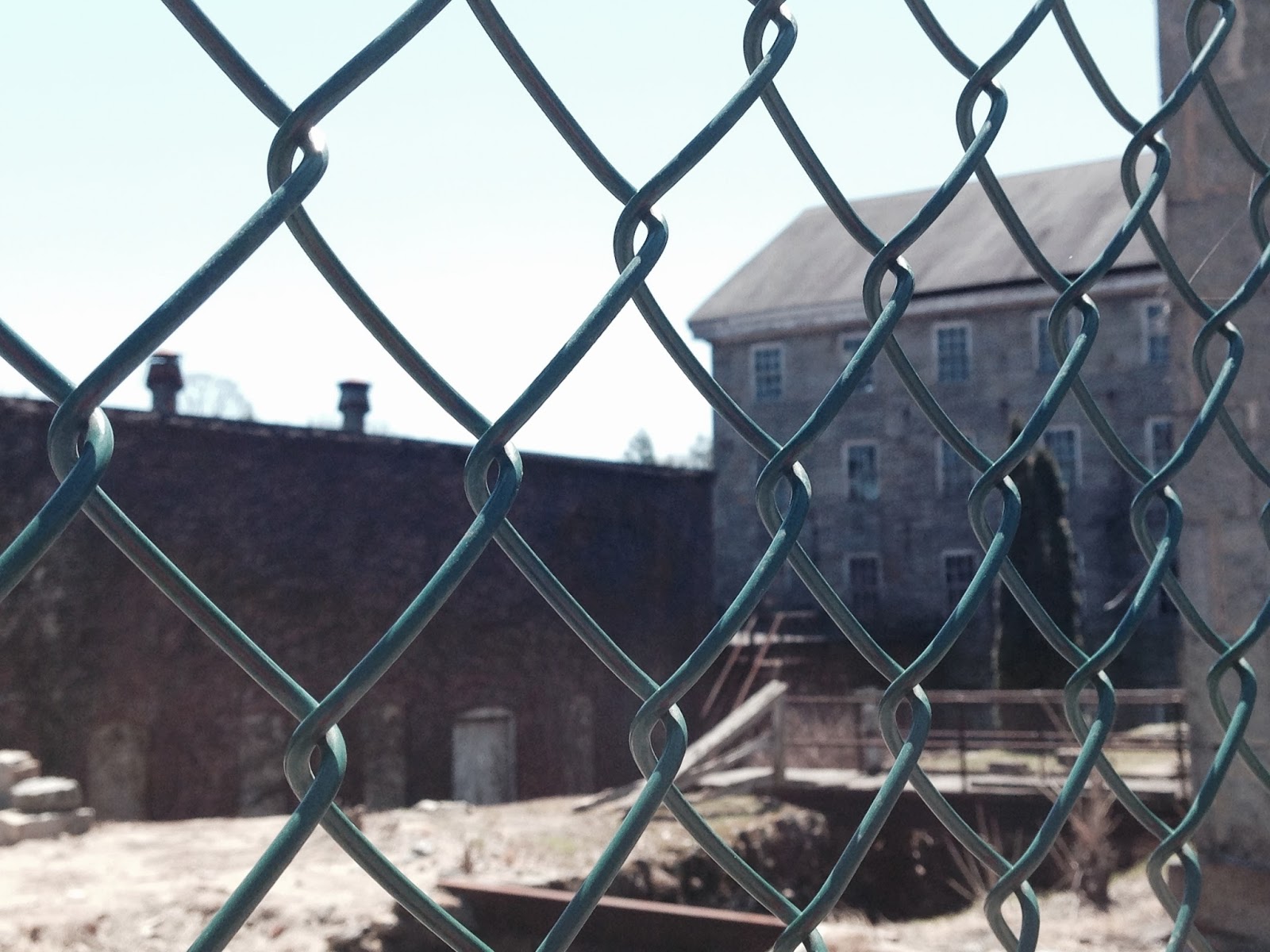
So there I was, knowing little of Ct.'s Mill history. Knowing only what I'd learned a zillion years ago, that there once used to be a great indigeonous population which is why there are still many Native American names on streets and well, even the states name. The state is similar to MA in many ways, excepting its overall conservative nature. Puritans and Anglican Protestants made up it's early European settlement, with Irish, French Canadian, Eastern Europeans (Polish, German) and Italians coming later to help in the Industrial growth that brought advanced machinery and mass production of goods.
Of course the abundance of water ways led to the development of many small, medium, and even large places of Mill production. With the birth of the patent system, Ct. at that time (1790-1930) had more patents issued per capita than any other state. Then of course there were the railroads, which came around 1840. Looking for those two things: water and railroad tracks leads me on many journeys. Then of course I am always on the hunt for Mill Street or River Street. Didn't find a Mill St. this sojourn, but did find River St.
Much of this Eastern traverse along Route 190 was rural and I was surprised at the number of farms I saw. I could envision early colonial life. What I have a hard time doing is going even further back, that is until I saw waterways. For some reason I so love the little rivers, brooks, and streams of our Eastern states. Even the lakes thrill me. But the sound of the rushing water and the concept of harnessing its power to produce goods just thrills me.
Although remembering Mark Twain's "A Ct. Yankee in King Arthur's Court," and having grown up with the vision of what that "Yankee" was: shrewd, hard-working, with mechanical ingenuity, and proudly independent, I really enjoy trying to envision the advent, then lure of the Indutrial call that pulled many a Yankee off the farm and into these little pockets of riverside industry.
Textiles had its day! Of course there were other goods produced, but mostly I saw woolen and cotton (yup cotton, and before emancipation too, can you imagine that? And the North didn't participate in the slave economy of the South, right?).
Stafford Springs, Ct. was larger than I thought in both population (12k), and land (3rd largest area in the state). The main thoroughfare is as one would imagine for a small mill town though: a section or merchant block, railroads running adjacent to water, mills on the next outer ring, mill housing right by, mill owner's houses further up on hillsides, and mill ponds and water falls. Quaint and just what I love!
 |
| The left bank includes the 135 yr. old Grace Episcopal Church + Hx'ical Society next door. Behind church are homes on Highland Ave. Right bank below is the RR and merchant blocks on Main St. |
 |
| The Hx'ical Society, of course, wasn't open :( I rarely hit it right to get inside these places. |
 |
| Down the hill from Highland Terrace is the RR and Merchant shops of Main St. |
 |
| My favorite re-do was this cute Cafe where I got a coffee on this blustery Spring vaca day. |
 |
| Across Main St. in a vacant lot they created an outdoor art space! |
 |
| I thought, although an eyesore to some, the remnants of the cleaved bldg. tells a story. Just look at all that is going on on the side of this building. |
 |
| Further down river is the center of town |
 |
| The old train depot is now the police station and across the street is the Stafford Springs Congregational Church (gathered in 1850) |
 |
| Silent No More! Now housing a Yoga Studio, Dance Studio, Naturawl- a healthy something-or-other, AND a Thrift Shop + Book Attic- I could have stayed all day!!! |
From the Hartford Courant:
By LINDSAY FORTADO; Courant Staff Writer, August 11, 2003
All that's left to remind the world of the once-thriving B.P. Cooley Co. is a silent mill next to the railroad tracks and one last employee. Frank Paris, a short, muscular man with tanned skin, hears only the clump of his work boots inside the mill as he walks across the aging hardwood floors, preparing the last of the bales of wool and the machinery for sale. Until owner William Craig Leuthner died of cancer in mid-2002, the company processed wool shoddy -- scraps of fabric, yarn and raw wool torn into fibers by machines and resold in bales.
 |
| Didn't mean to selfie it, but found this picture and the one below on the walls of this lovely mill that sits almost mid-downtown on the Middle River. |

 |
| Heading up to Furnace Rd. to the remains of the day, as the picture and link below sort of tells the story of the death of another mill :( |
Warren Corp. Shutting Down
Silence mostly up this part of town, excepting the lovely sound of the falling water. Notice also in the next two pictures how they are different. Two mile falls created in close proximity to each other. The nature of the land is so fascinating to me.
Then there was all the gorgeous (to me) extant mill housing:
 |
| Company town, company stores, company housing. Work, work, work that was the American way back then. Now we are lucky to even have a part time job, and most of the mills are gone. Geez, that pendulum sure does swing! |
 |
| I liked how many of the mill houses in this town had dormer windows. |
 |
| But not all! Look at the difference between the top and then the bottom. The housing in these old mill towns were as stratified as the employees were. Location and construction told a great deal about the people living inside (and sadly in most cases of these old mill houses still do). |
Then of course there is the Supervisor's, Foreman, and Owner residences, most of which are elevated in some way. This first picture tells of the history (or when industry began to leave, head south to be closer to the raw product, get cheaper wages, etc.) as some of these grand places just begin to crumble and fade
 |
| These pictures above and below are located close to Furnace St. |
 |
| Who I wonder lived at this home on top of Highland Terrace? |


 |
Just look at all that detail work on this home! But what is that chair in the front yard? A curio?
|
 |
| A potty chair!?! In the front yard? I almost used it, wanted to steal it, but did neither- just photographed it. Mystery remains. |
And finally were some other mysteries, requims to the past, and assorted spottings. I really enjoyed this place (NO I did not go anywhere near the motorway, in fact I pretended it didn't even exist, even though it was the only thing I knew about this place before I visited).
 |
| A piece of the Grace EpiscopalChuch. Simple elegance. |
 |
| The non-existant spring! Here is a blurb on the Hx of SS from connecticutthistory.org:
Located in Tolland County on the Massachusetts border, Stafford is, in terms of land area, the state’s third largest town. Early on, Iron bogs and mineral springs drew indigenous peoples and settlers to the area. Incorporated in 1719, Stafford became a resort town as growing numbers of people, including President John Adams, sought out the waters’ curative powers. In the late 1800s, as the springs’ popularity declined, textile mills, a button factory, and other enterprises formed Stafford’s industrial hub. Today, with its lakes, streams, farmlands, and Shenipsit State Forest, Stafford retains its rural character.
|
 |
| The last pictures are the remains of the day. Goodbye Warren Mill, may good karma come your way and a reincarnation/rebirth happen soon. |
Op Ed from Courant