From Rt. 20 in the Springfield, NY area (yes I added a Spfld. to my "find all the Spfld.'s in the US" list) I took a left turn onto Rt. 10. Now if you've never been in the NY area off of the big routes, let me tell you- you can quickly get into smaller and smaller towns, yet larger and larger tracts of vast rolling hilled farm land. And while this is a lovely view that often stuns the eye and affords some great shots, after a while it gets redundant. The Amish provided a break in the redundancy, but then they too were gone. So near Cooperstown, at the intersection of Rt. 20 and 10, I took a left as a way to wend to Canajoharie, NY to see the now defunct huge Beechnut Plant (since I was after all on the "Rust Never Sleeps" tour).
I couldn't tell you how far I got when I came upon this,
"Oh how quaint", I thought. Because after all, Villages really are quaint, that's the whole purpose of the term in my mind. So I wended along wondering where the water source was, and if the springs would be operational and touristy like in Southwestern Colorado.
Sharon Springs is a sulfur bath resort town in Central NY. Development as a mineral water spa began in 1825 with the establishment of David Eldredge's boarding house. Several large hotels and boarding houses were built and by 1841 the village had become world famous.

What I found was more like a broken down ghost town. A few bizarre tidbits about the place:
- Population is about 550 residents
- There is a Sharon Springs, Kansas that was founded by former members of this town.
- There are/were sulfur, magnesium, and chalybeate (impregnated with salts and iron) springs in the town.
- At its peak the village hosted 10,000 visitors each summer. By contrast, on this overcast gray day in August 2014, it hosted one-me!
- This once fashionable spa village was mainly host to fashionable wealthy Jewish families of German origin who were not welcome at the OTHER fashionable and popular spa resorts of Saratoga Springs, NY due to the prevailing social bias of the time.
- Sharon Springs village is low income meaning there is a disproportionately large percentage of households that have an annual income under $25,000.
- Prohibition and the opening of the NY State Thruway both acted to kill the village in the early 20th century.
What I saw as I drove thru:
 |
| Prohibition may have helped kill business in the early 20th century, but this old inn-looking alcohol establishment looks as if it is trying to bring the business back in the early 21st century. |
 |
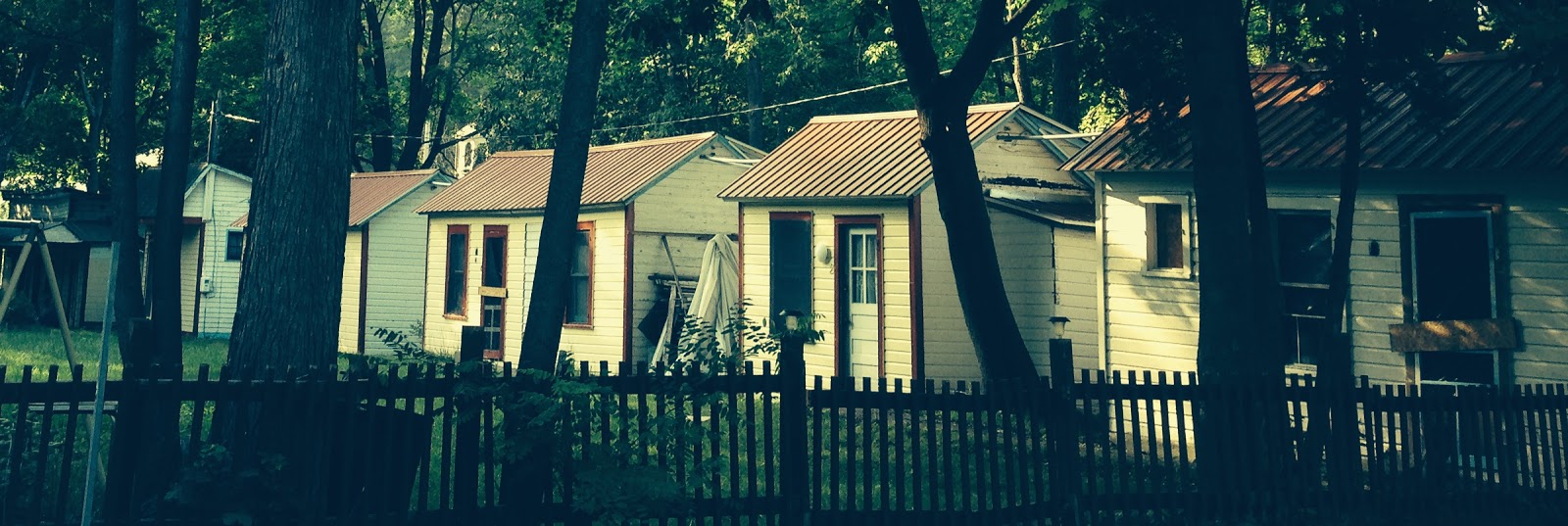
| Am unsure if this is one of the Kuchaleyans that flourished from 1920's thru 1960's. These were self-catered boarding houses, and in Yiddish the name means "cook-alones." They were a more affordable alternative to the larger more expensive hotels and were especially popular during the depression and, later, with poorer post-war European refugees. Or the home could be a Hasidim guest house, I am unsure if these are the same thing. The Hasidim Jew's were later arrivers who re-inhabited some of the hotel and guest houses that had seen their heydays earlier in the 20th century. |
 |
This brick building was built in 1910. It operated as the Smith, Empie & Smith Department Store until the 1950's. Later it was run as a variety store, grocery store and soda fountain. In the 1960's and early 1970's, it was occupied by a mail order company and still later, as an art gallery. It is now used as an antique shop. Klinkhardt Hall was built in 1884. It is located on the corner of Main Street and Division Street. The building is made of brick. Originally it was a combination of an upstairs opera house and a downstairs hardware store. After a fire in 1911, in which Mrs. Klinkhardt was killed by an exploding can, the Masons bought the building. Masonic Lodge rooms were on the second floor and Smalley's Movie Theatre was on the first floor. The building is no longer in use.The Sharon Historical Society received a grant in 1994 for historical recognition of the spa area. Approximately 180 buildings have been granted National Historic Place status. Today, Sharon Springs continues to operate as a mineral waters spa with a small clientele of primarily Hasidic and Russian Jews, however on a much smaller scale than in the glory days of Sharon Springs.  They're trying... But it doesn't look good  They got as far as a "Welcome to" 
Chalybeate Temple
The Chalybeate Spring contains iron and was especially beneficial for treating anemia. The Chalybeate waters reputedly had enough iron salts to turn one's teeth brown, nevertheless it was bottled and sold for its medicinal use. Listed on the National Register of Historic Places, the Temple has been renovated and summer concerts are held in the park.
 
Sulphur Temple
In 1927, Alfred Gardner built the beaux-arts style White Sulphur Temple that replaced an earlier one. This elaborate, classical, and octagonal temple features eight fluted columns topped by plaster Corinthian capitals, which support an elaborate cornice decorated with brackets shaped like acanthus leaves and dentils. Listed on the National Register of Historic Places, the temple is open to the public; there is no charge to drink the mineral water. The sulphur water is 48 degrees Fahrenheit and flows freely year around.

Magnesia Temple
The most unique of Sharon Springs temples is the elaborately ornamental, domed Magnesia Temple. In 1860, a man of wealth, Henry J. Bang, began beautifying the grounds around the springs by building arbors, temples and laying out walks. The Magnesia Temple, ca. 1863, is the only remaining structure of the Congress Hall complex which once included bathhouses, a bandstand, and gardens. The triangular pediment, dentils in the cornice, and Corinthian columns identify it as Renaissance Revival. Stone steps lead to the fountain where famously refreshing and medicinal magnesia waters once spouted from the mouths of the twin stone lion heads. Over 140 years later, the temple, although in need of repair, still symbolizes the spa's glorious past. Listed on the National Register of Historic Places, the temple is located on the grounds of a private residence.      
Imperial Baths
The Imperial Bathhouse was opened July 1, 1927. It is located in the center of Sharon Springs Historic District. It offered sulphur baths, massages and mud treatments to relieve pain and as a cure for a variety of illnesses. As many as 5000 treatments could be given in a single day. It is still open during the summer. Although in advanced deterioration today, one of the original 1876 bath-houses remain, the other having been demolished in the early 1960’s. The architectural historic integrity of the remaining bath is remarkably intact with most of its tubs and oiled hardwood walls.
Now, there were a few updated and functioning places in the village. Chief among them is the American Hotel.

It is a large, 31⁄2-story wood frame structure built between 1847 and 1851 in the Greek Revival style. It features a recessed 2-story porch with a colonnade of eight pillars with Doric order capitals supporting the roof.
Okay, now here comes another oddity about the town: The hotel and owners Doug Plummer and Garth Roberts appear in the reality television series The Fabulous Beekman Boys, which takes place in Sharon Springs. The series debuted in June 2010.

I found this poster on the, of course closed, Historical Society building. More on this:
The series follows Josh Kilmer-Purcell and his husband Brent Ridge as they learn how to become farmers and launch their lifestyle brand, Beekman 1802. Brent, a physician who previously worked for Martha Stewart Omnimedia, lives at the farm full-time, while Josh, a New York Times bestselling author, commutes from their apartment in New York City on the weekends. The show originally aired on Planet Green, one of the Discovery Networks, but was acquired by Cooking Channel, a network owned by Scripps Network Interactive in 2012.
Touted as a "gay Green Acres",[1] the series chronicles the couple's trials and tribulations as novice farmers, aided by their caretaker and resident farmer John Hall, or "Farmer John." Hall brought his goats to the Beekman Farm shortly after Ridge and Kilmer-Purcell purchased it in 2007. Also featured is Polka Spot, the farm's llama. Other residents of Sharon Springs, New York are also included in the cast, including Doug Plummer and Garth Roberts, owners of the American Hotel.
On August 9, 2010, Planet Green announced that The Fabulous Beekman Boys had been renewed for a second season of ten episodes. In announcing the renewal, Laura Michalchyshyn, President and General Manager of Planet Green, noted that the series "has quickly established itself as a cornerstone franchise for Planet Green".[2] The second season began on March 22, 2011.[3]
Planet Green declined to renew The Fabulous Beekman Boys for a third season based on low ratings.[4] However, Cooking Channel announced in April 2012 that it had picked up the series for a third season. The channel plans to repeat the first two seasons with additional footage as well.[5] The pair also participated in the 21st season of The Amazing Race, ultimately becoming the season's grand prize winners.
Well now I have some good diggings and winter watching to do, now don't I!?! Who'da thunk it? How'd I found it? Oh journeying, journeying.
But that's not all folks, because even though a pop. of >1,000, the town has like 170 historic buildings listed (how they are ever going to get them all in shape w/ a pop. deemed poverty-stricken is beyond me (although I think I read somewhere about Korean investors or something). So let's travel on.

I feel bad that I passed up this seemingly only open and functioning establishment for a cup of Joe (although I think I could've also grabbed a gallon or 8 of booze earlier up the street, but alas...I bypassed these establishments because I was astounded by the rot and decay.
 
The Roseboro Hotel is located on the southeast corner of Main Street and Washington Street. The 1850's Howland House, The 1896 Rosenberg Hotel and the 1870's Rosenberg House, were joined with connecting additions in 1900 to form the Roseboro hotel current 45,000 square foot building. The Roseboro hotel had 135 rooms, (but only 27 bathrooms!) one of the first sprinkler systems and a 1939 Otis Elevator.
Between 1904 and 1909, the old Howland House, on Main Street, and the Rosenboro Hotel, on Washington Street, were joined into one large hotel and renamed the Roseboro Hotel. The building has a number of Queen Anne and Colonial Revival style decorations, including the porch rails and the wood sunburst over the main entrance. It was closed during the 1960's. It is now being restored by current owners Dawne Belloise and Dominic Giacomo.

This structure adjacent to the side of the Roseboro on Washington St. is operating as a B&B called The TurnAround Spa Lodge. Their billing makes me want to come back and stay for a night (or two):
This fine lodge with six comfortable quiet guest rooms in a lovely mountain side rural village setting will soften any stress while nature begins your restoration!
On premise is a private library which includes Dr. White's original books on Health and Healing.
The private Jacuzzi room and individual mint steam bath are available to our guests.
Only steps away are three different mineral water fountains.
"Stylishly Relaxed"
Saturday evenings are formal comfortable.
Those seeking Escape & luxury of quiet and rejuvenation will find this the perfect affordable destination!
Basic room w/o services for two starts at $45 per night.
Deluxe package is $135 per night for two persons.
Includes;
* Internet
* Herbal Jacuzzi
* Mint steam sessions
* Massage or body rub
* Spa treatments are priced on duration
Hey, it's no Berkshires Canyon Ranch or Lake Austin Spa Resort, but sure looks like a "bang your buck" and great exploring spot to me! I am bookmarking this and dragging hubby back someday. I bet it is spectacular in the fall.
The Columbia Hotel
The Columbia primarily catered to New York City's Jewish population following the second World War. After the decline of the Borscht Belt region (a Jewish , much of the town catered in particular to Orthadox and Hasidic Jews; the Columbia was one of several hotels that did so, adapting all kitchen facilities to follow Kosher law, and removing the televisions from the establishment.
Unlike the Adler, the Columbia was primarily a long-term hotel; rooms were rented by the week (at an average of $140 per in 1977). Except for the tiny economy rooms on the top floor, every room came with a kitchen across the hall; guests of the hotel would be given keys to both. There was some light evening entertainment offered at the Columbia; noted Ukrainian dance musician Michael Skorr performed there for 18 consecutive summers. However, many guests would opt to head over to the Adler for the more elaborate comedy shows and vaudeville acts featured over there. Like the Adler, the Columbia shuttered its doors after the 2004 season; its fate remains in the air.   The Adler Hotel was the last large hotel built in Sharon Springs. It opened in 1929 and cost $250,000. The Adler Hotel has a capacity for 150 guests. It has a ballroom and its own mineral bath facility. It is a four-story mission style building with a large center gable.  The Adler was once a bustling resort town built upon a natural mineral spring. It was thought that the high levels of sulphur, magnesium, and iron in the water provided a variety of health benefits, the exact specifications of which varied widely over the years. By the end of the 19th century, it was a highly fashionable escape from New York; patrons included the Vanderbilts and Oscar Wilde. By the time of the Depression, there were more than a dozen resort hotels operating out of the town, alongside a highly regarded golf course, a number of bath houses, and other amenities common to resorts of the era. Among the last of these built was the Adler, which first opened its doors in 1927. Already the town was fading; Saratoga Springs was competing for, and for the most part winning, the patronage of the prestigious. Add to this the economic hardships of the Depression, which happened only a few years after the hotel was built, and the hotel was economically troubled from the beginning. But after World War 2, the town again came into prominence, now as a getaway spot for wealthy German Jews, who were not welcomed easily at Saratoga. In 1946, Ed Koch, future mayor of New York, bussed tables at the Adler. The town was again booming, and the kitchens in all of the old resort hotels were made Kosher; in a phenomenon not unlike the Borscht Belt of lower New York, Sharon Springs became a major Jewish escape. But the decline of resorts in general, as well as the building of the New York State Thruway, which bypassed Sharon Springs, took their toll. One by one, the resort hotels and bath houses closed; the Adler was among the last to shut its doors, in 2004. Since then, little has changed there - the occasional vandal has sadly snuck in, and there is graffiti vandalism throughout various areas of the hotel, including the grand dining room. But things are looking up for the hotel - unlike other notable Sharon Springs hotels, such as the Pavilion and the Washington, it was not demolished; now it has been purchased by a group which plans to restore it (as well as the Imperial Baths and the Columbia Hotel) and remake Sharon Springs into a resort community once again. Hopefully, this grand five-story Spanish Revival building will once again see life. to see more pictures on both the Columbia + Adler Hotel, go to this link: http://kingstonlounge.blogspot.com/2010/04/hotel-columbia-sharon-springs-ny.html   
I don't know if this is the remains of something that was a part of the Adler, or a private residence, or a farm, hunting lodge, another Inn??? It has made me crazy for a week. I am abandoning hope of ever finding out. I have searched and searched. The most amazing thing I think I found in all this is how many, many, many others like me take to the roads in search of our abandoned heritage. Lots of blogs and/or photographers capturing the decay. Wonder what it is we have in us that enjoys these types of journeys? I don't know, can't articulate it, but I just enjoy it, I just do.
|


